1
Tank, substrate & hardscape
Pick a tank size you can maintain, lay a nutrient-rich aquasoil, and arrange rock and driftwood before a drop of water goes in.
Week 1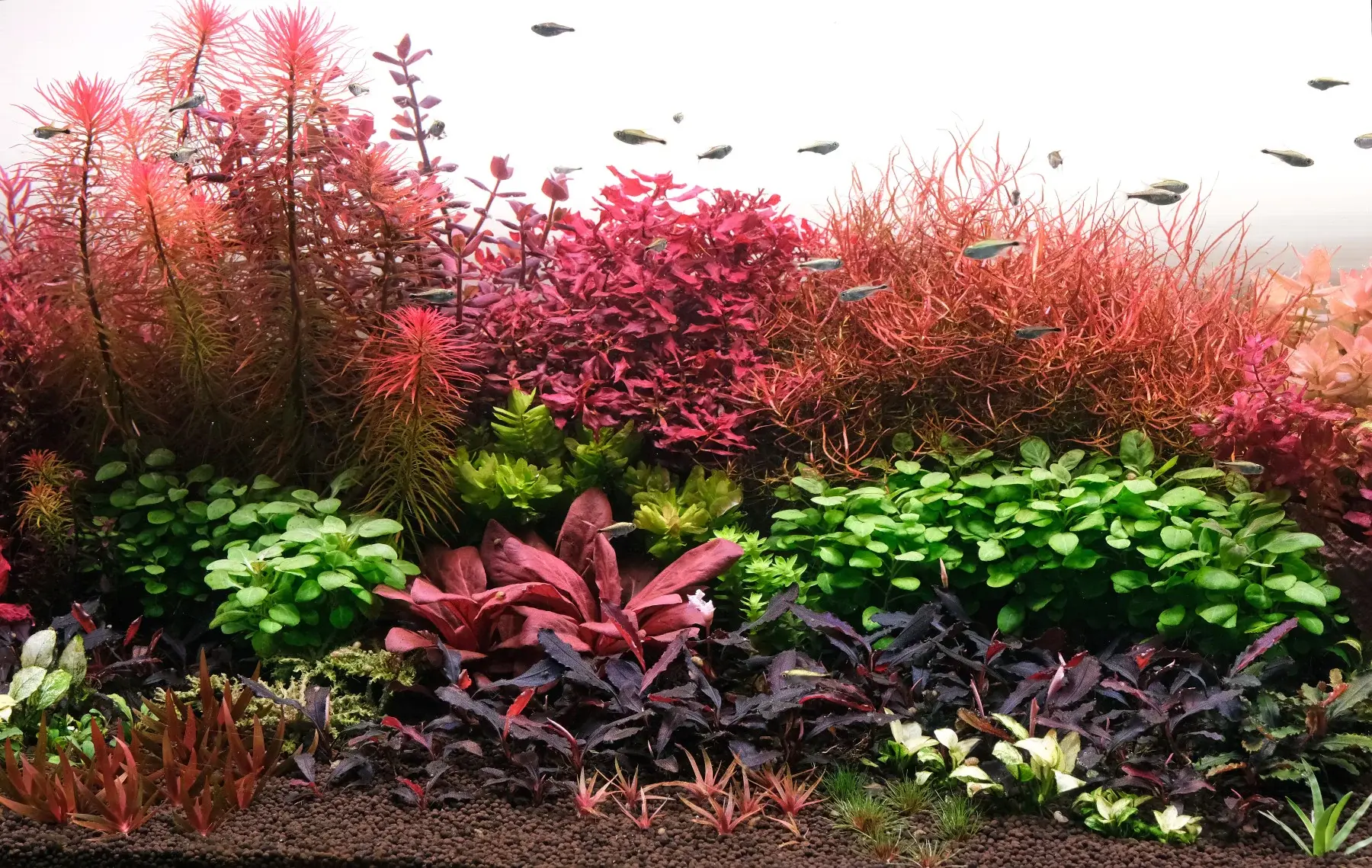
Step-by-step guides for people setting up their very first planted aquarium — which plants won't melt on you, whether you actually need CO₂, and how to beat algae without emptying your wallet.
Where you're headed: a mature Dutch-style scape with injected CO₂. Most beginners start simpler — and that's exactly the point of the roadmap below.
Start here
Four stages, in order. Skipping ahead — especially adding fish before the tank is cycled — is how most first tanks go wrong.
Pick a tank size you can maintain, lay a nutrient-rich aquasoil, and arrange rock and driftwood before a drop of water goes in.
Week 1Set your light to 6 hours a day, plant heavily from day one, and fill slowly. Dense planting is your best algae insurance.
Week 1–2Let the filter bacteria establish. Expect some melting leaves and a possible algae cameo — both are normal, neither needs panic-buying.
Week 2–6Add shrimp or a small school of fish, settle into weekly water changes and trimming, and watch the tank mature.
Week 6–12
Featured guide
Everything in one place: the full setup, in the order you'd actually do it, with the mistakes flagged before you make them.
Latest guides
Each one answers a single question properly — including the parts where the honest answer is "you don't need to buy that."
Start hereTank size, substrate, planting order and the first month — the calm, step-by-step way to start.
CO2The whole system in plain words: the parts, the 30 ppm target, timing with your lights, and safety.
 Low-tech
No cylinder, no problem. The light-first method and the easy plants that genuinely thrive on it.
 Algae
Name the algae first, then fix the cause. A playbook for the six types every beginner meets.
 Fertilizer
Who feeds from the roots, who feeds from the water — and a starter dosing rhythm that works.
 Plant SOS
Melt is usually adaptation, not death. How to tell the difference, and exactly what to do this week.
Interactive tool
Dissolved CO₂ is estimated from your water's carbonate hardness (KH) and pH using the standard KH–pH relationship. Measure pH with the lights on, mid-photoperiod, for a reading that means something.
From your liquid KH test kit. Most tap water sits between 2 and 8 dKH.
Compare against your tap water's pH — a drop of about 1.0 point usually means you're in range.
In the target zone. Plants get plenty of carbon without stressing livestock.
Formula: CO₂ (ppm) = 3 × KH × 10(7 − pH). It's an estimate — peat, aquasoil and other acids can skew it, so treat your drop checker and your fish's behaviour as the final word. If fish are gasping at the surface, turn the gas down first and troubleshoot later.
Plant finder
Filter by the light you own and whether you inject CO₂. Everything listed is widely available and forgiving — difficult plants are deliberately left for year two.
| Plant | Position | Light | CO₂ | Growth | Good to know |
|---|
Gear, honestly
Typical US prices for a 10–25 gallon setup, before plants and livestock. The middle kit is where most beginners are happiest — it grows everything on this page without the gas cylinder.
Typical total for 10–25 gal
Typical total for 10–25 gal
Typical total, fully loaded
Straight answers
No. A large group of plants — Anubias, Java fern, crypts, Vallisneria, most mosses — grows perfectly well without injected CO₂, just more slowly. CO₂ becomes necessary when you want fast growth, dense carpets, or deep red colours from demanding stem plants. Start without it; add it later only if you outgrow the low-tech plant list.
Most aquarium plants are grown out of water at nurseries. When submerged, they shed their land leaves and grow new underwater ones — it looks like dying, but it's a wardrobe change. Don't dig the plant up: if the roots or rhizome are firm, new growth is coming. Remove fully rotted leaves so they don't foul the water.
Start at 6 hours a day for the first month, then increase by 30–60 minutes a week up to 8 hours if the tank stays clean. Algae almost always traces back to too much light for the amount of plant growth — when in doubt, shorten the day before you reach for chemicals. A cheap plug-in timer makes this effortless.
Please don't. A new filter has none of the bacteria that convert toxic ammonia into safer compounds, and that colony takes roughly 3–6 weeks to establish. Plants and shrimp-friendly patience now, fish later — the tank will reward you for it. Test for ammonia and nitrite reaching zero before stocking anything.
More plants. A tank planted densely from day one has dramatically fewer algae problems than a sparsely planted one, because the plants consume the nutrients algae would otherwise feast on. Second place: a liquid test kit — it turns guesswork about cycling and water changes into actual information.
One page, in the order you'd actually use it — shopping list, setup day, and a week-by-week rhythm for the first 90 days. Print it, tape it to the tank stand, tick things off.